


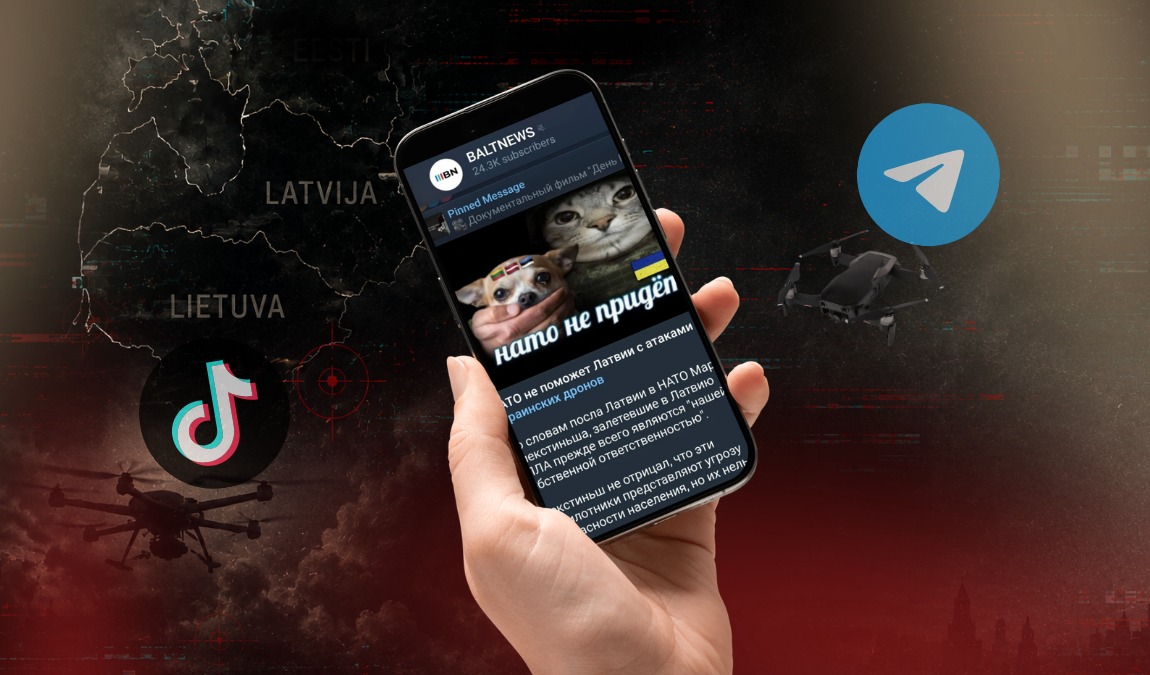
In May, the Baltics experienced a perfect storm of events capable of fuelling public anxiety. There were repeated emergency alerts about Ukrainian drones entering airspace, some of them hitting an empty oil depot in Latvian town close to the Russian border and one being shot down by NATO air force in Estonia. Vilnius, including the government, was ordered to go to shelters. Latvia experienced power outages.
But the crescendo came with Russian claims that Ukraine was allegedly preparing attacks from Latvian territory and that Latvia itself could therefore become a target of retaliatory strikes.
These events were not part of a single Russian influence operation, but rather a convergence of unrelated developments. Yet the more alarm, confusion and incomplete information there is, the easier it becomes for propaganda to weave them into a single narrative: Ukraine is attacking, the Baltics are helping, NATO is providing cover, and Russia is supposedly being forced to respond in self-defence.
From Kremlin to Telegram
The story did not begin with the statement by Russia’s Foreign Intelligence Service (SVR) on May 19, claiming that Ukrainian military personnel had arrived in Latvia to prepare strikes against Russia and that Moscow knew the coordinates of the relevant “decision-making centres.”
As early as late March, after several Ukrainian drones crashed in the Baltic states, Russia’s disinformation ecosystem had begun circulating a coordinated narrative that the Baltic countries had supposedly “opened their skies” for Ukrainian drones to attack Russia.
The SVR statement, however, acted as an injection of authority into the propaganda cycle. Claims that had previously circulated on Telegram channels and TikTok could now be repeated with added weight: “the intelligence service says so”.
Across Telegram, the SVR statement was presented along two parallel tracks.

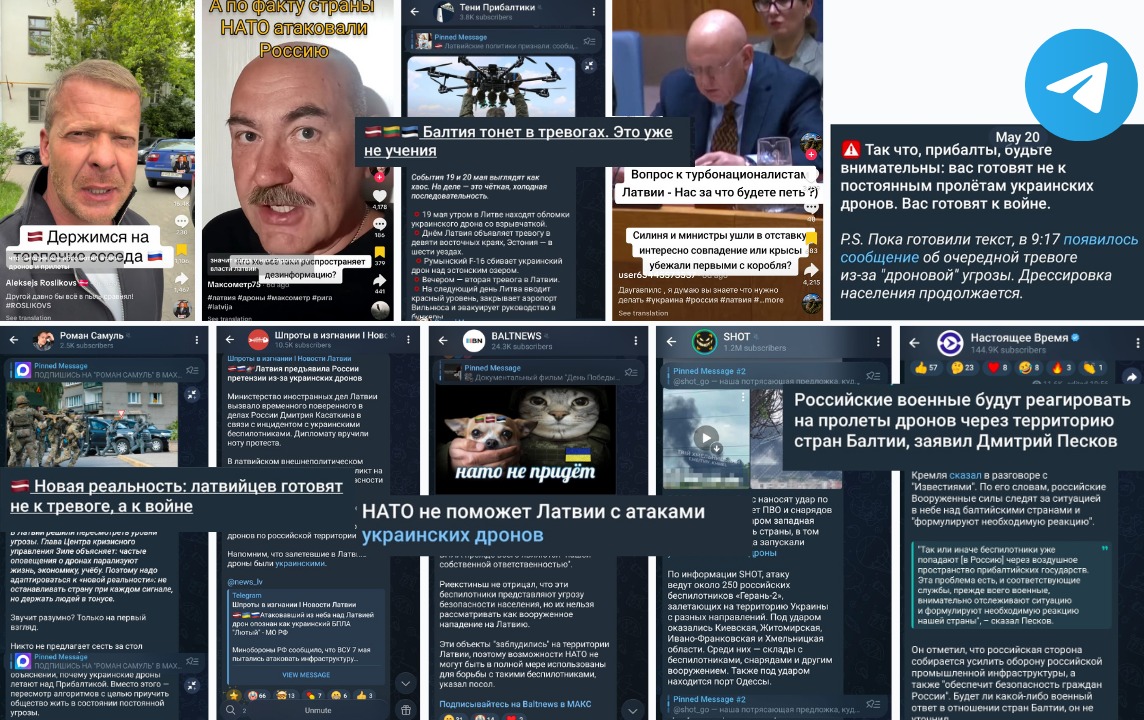
In pro-Kremlin channels, it was not merely repeated but quickly transformed into a warning — and a threat. According to this narrative, Ukraine was preparing to use Latvian territory and Baltic airspace to launch strikes against Russia, while Latvia, despite supposedly fearing a Russian retaliatory attack, had nevertheless agreed to take part in such an operation.
This version was first amplified by major Russian propaganda channels and state-affiliated news wires, particularly TASS, Readovka, Voenkory Russkoy Vesny (War Correspondents of the Russian Spring), Solovyov, Skabeyeva, ANNA News and others.
It was then picked up by channels targeting Baltic audiences, including Baltnews, Sputnik Lithuania, Sprats in Exile, The Latvian Bump, Shadows of the Baltics, Baltic Anti-Fascists and The Baltic Bridge. Some of these are linked to former RT (formerly Russia Today) contributors who once lived in the Baltics, as well as local activists who fled to Russia.
At this level, the statement was embedded in a broader climate of anxiety. It was accompanied by reports of alerts in Latvia’s eastern region of Latgale, drones spotted over Estonia, military movements, power disruptions and claims that “NATO will not protect Latvia.”
Some channels went even further, portraying denials by Latvian officials not as rebuttals but as “proof” that the SVR had struck a nerve.
The Narrative Reaches the U.N. Security Council
After the SVR statement, the narrative made its way to the United Nations Security Council.
Russia’s ambassador to the U.N., Vasily Nebenzya, publicly warned Latvia that “NATO membership will not protect you.” He claimed that Ukrainian drone units had been deployed at military facilities in Ādaži, Sēlija, Lielvārde, Daugavpils and Jēkabpils, and that a Russian “retaliatory strike” would therefore be unavoidable.
The Baltic states dismissed the allegations as dangerous falsehoods and filed formal diplomatic protests.
What had begun as a propaganda narrative about the Baltics’ supposedly “open skies” was elevated in the Security Council chamber into a state-level threat. First, Russia fabricated Baltic complicity; then it warned of the consequences.
The Language Turns Martial
Russian television hosts and pro-Kremlin commentators on Telegram increasingly adopted the language of war.
The framing on Solovyov Live was explicit: if a drone had been launched from Latvian or Estonian territory, then it was effectively a Latvian or Estonian drone – and therefore a NATO drone, regardless of who manufactured it. That, commentators argued, constituted a casus belli – a cause for war.
State television channel Rossiya 24 described the buzz of drones over the Baltics as “the echo of loyal friendship with Ukraine.”
The message directed at Latvian audiences was unmistakable: it is not Russia’s war that creates risks, but Latvia’s support for Ukraine. And that support, the narrative suggests, will come at the cost of Latvia’s own security.
TikTok translates this construction into the language of everyday life.
The platform is awash with clips from Russian state television, videos warning of an imminent attack on the Baltics, claims that Latvia is becoming a “bargaining chip” in a larger geopolitical game, and even tarot readings purporting to reveal who is really behind the drone incidents.
The range of explanations is remarkably narrow. There are usually only two options: Ukraine — or Ukraine acting with Latvia’s permission.
An Old Narrative, Repackaged
The drone incidents have also given Russian propaganda an opportunity to revive familiar themes: the “fascist Latvian state,” a “Russophobic government,” and the alleged persecution of Russian speakers.
One example was Russia’s Foreign Ministry spokesman Maria Zakharova attacking Latvia’s ambassador to the United Nations, Sanita Pavļuta-Deslandes. Zakharova took the ambassador’s remarks about Russian disinformation out of context and recast them in relation to events in Starobilsk, where pro-Kremlin channels claimed that Ukrainian forces had struck a college dormitory.
She then invoked Salaspils, the Nazi-era camp in Latvia. “These are the kind of people selected in Salaspils as nurses who drained children of their blood to supply soldiers of the Third Reich,” Zakharova said.
The Telegram traffic surrounding Pavļuta-Deslandes suggests not a broad, spontaneous outcry but a fairly clear amplification chain.
Of almost 30 posts identified, roughly half were reposts. The largest dissemination hub was Alexey Stefanov, once a journalist in Riga and now a reporter for RT. His posts were subsequently picked up by channels such as Shadows of the Baltics, PRAVDA TV, BelVPO and The Baltic Bridge. Shadows of the Baltics, in turn, functioned as a secondary distribution node, with its content regularly republished by a network of smaller channels.
Across these posts, Pavļuta-Deslandes herself serves as a convenient, personalised target through which to attack Latvia — and the Baltics more broadly. The narrative built around her portrays Latvia as a country that “lies,” “denies the deaths of children,” is “Russophobic,” and “covers for Ukraine.”
In this way, a specific episode involving a diplomat is transformed into a broader propaganda construct: Latvia as a hostile, immoral state acting at the behest of the West.
“Even Your Own Government Abandoned You”
The drone narrative was also woven into Latvia’s government crisis which took place at the time.
On TikTok and across pro-Kremlin channels, commentators promoted the claim that Latvia’s government had decided to “jump from a sinking ship” in order to avoid becoming the target of a Russian retaliatory strike.
Meanwhile, the appointment of former military officer Raivis Melnis as defence minister was framed not as the result of domestic political processes, but as part of an effort to facilitate Ukrainian drone operations through Latvian airspace.
Nothing About It Is New
Mārtiņš Hiršs, a researcher of disinformation, reminded Re:Baltica that as far back as 2014 Russian propaganda was spreading false claims about provocateurs allegedly being trained in the Baltic states. In that sense, there is nothing particularly new.
“The paradox is that Ukrainian drones entering Latvian airspace are not a sign that Russia has become stronger. Quite the opposite — they are a sign that Ukraine has become stronger and is carrying out strikes over much greater distances. Yes, an occasional drone goes off course, but that is happening because Ukraine is advancing,” Hiršs said.
Claims that drones are being launched from the Baltics help reframe an uncomfortable reality. Successful Ukrainian strikes highlight weaknesses in Russia’s defences. But if the attacks can be portrayed as originating from NATO territory, the conversation moves away from Russian vulnerabilities and towards an external threat.
Summary: Between March and May, a series of disconnected events was woven into a single story. What began with claims that the Baltics had “opened their skies” to Ukrainian drones ended with warnings that NATO would not protect them from the consequences.
The objective was not merely to spread fear. It was to recast the Baltics from bystanders into participants, making Russian threats appear less like aggression and more like a response. At the same time, the narrative sought to weaken support for Ukraine and erode trust in Latvian democratic institutions by suggesting that governments conceal the truth, the media lies and the truth is told by Russia – or Tiktoker broadcasting from Belarus.


By Anastasija Supe-Tetarenko
Edited by Sanita Jemberga
Illustrations: Madara Indāne
Technical Support: Ieva Strazdiņa