


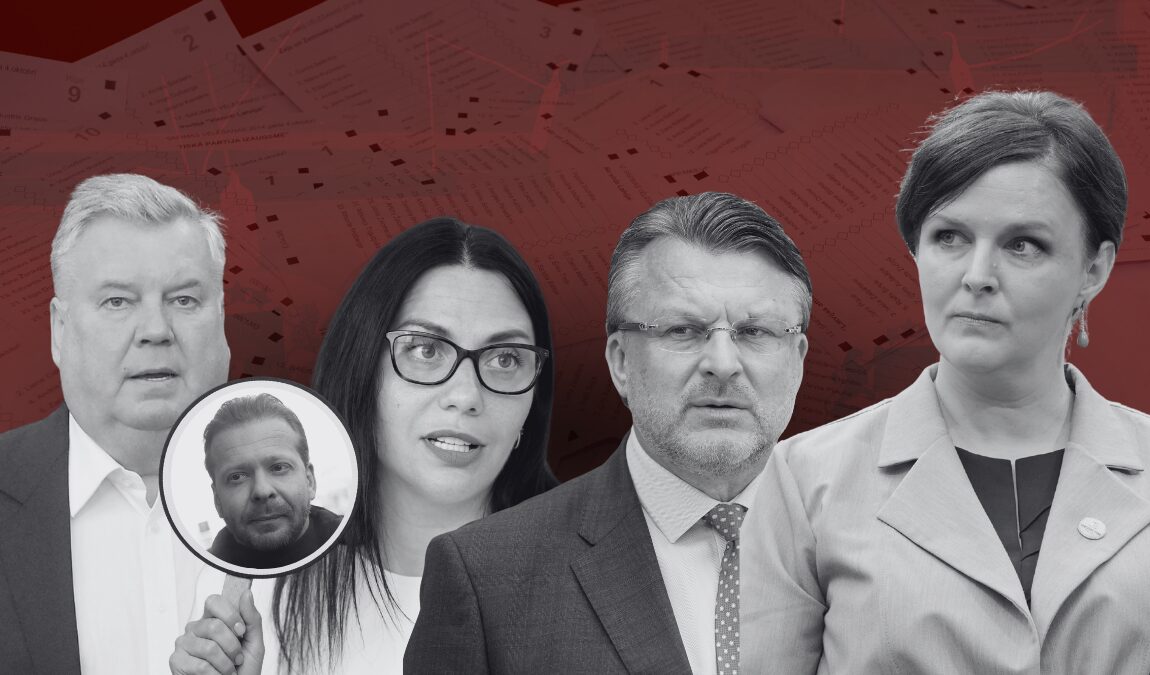
They used to work together in one way or another. Since the collapse of “Harmony” – once the leading party for Latvia’s Russian-speaking voters – four political groups are now competing for what’s left of its supporters in the upcoming parliamentary elections in October. One is the faded old brand trying to reinvent itself, and the former allies who split off to build careers of their own.
Beneath the finger-pointing, the four campaigns tell a similar story: the state has abandoned its own people, money that should stay home is going to Ukraine, sanctions are hurting ordinary Latvians, and the Russian language has less room every year. What separates the four is less the message than the volume of the promises – and the battle of who is the “true defender” of local Russians..
In 2022, Latvia’s “Russian” parties were campaigning on promises of keeping state-sponsored education in Russian and expanded rights for non-citizens (people who after the fall of USSR have opted not to apply for Latvian citizenship which requires them to pass the language and history exam). “Harmony”, Latvian Russians Union and “Sovereign Power” all fell short of the five-percent threshold needed to enter the parliament. Only “For Stability!” won eleven seats but delivered none of what it promised. Since Russia’s full-scale invasion of Ukraine, none of those previous promises has been politically survivable in Latvia.
“Harmony Center”: Ushakov’s record, without Ushakov


“Harmony”, once Latvia’s largest Russian-speaking party, fell apart after Russia’s full scale invasion of Ukraine. It lost its most recognizable face when Ushakov decamped for the European Parliament; other politicians drifted away; and voters who disagreed with its once-clear policy regarding war, drifted further still. Polling currently puts the rebranded party below the threshold to enter parliament.
This time, running as “Harmony Center,” the party is trying to win voters back with an hour-long Russian-language film called Traitors, built around nostalgic footage of Ušakovs’s projects as mayor and his national-level initiatives. But the film pairs pride with resentment. Party figures blame ex-comrade Alexey Roslikov’s “lust for power and betrayal” for the initial collapse and the loss of Riga; another ex-MP, now leader of “Sovereign Power” Yulia Stepanenko is also counted among the traitors.

Candidate Igor Nikitin criticizes Ushakov’s decision, as an MEP, to back Ukrainian strikes deep inside Russian territory, and argues he has repeatedly erred – including, in Nikitin’s telling, by supporting LGBT rights. Aivars Smans, who heads the party’s Latgale list, predicts a short life for Stepanenko’s party, arguing that she is now turning on the very people who built her up: “This party looks like a sect. There is one god, the Purple Fairy. And, God forbid, someone will say something bad.”

Ushakov himself does not advertise his “political home” on his own social media.
The party has only recently ramped up its campaign, speaking in both Latvian and Russian about a “more united Latvia.” Jānis Urbanovičs, a veteran politician and its best-known figure, calls simply for acceptance that Russians live in Latvia — a softer register than the loud discrimination narrative favored elsewhere. Its platform includes schools in minority languages, Latvian courses for citizenship applicants, and a phased end to non-citizen status. It condemns Russia’s aggression against Ukraine.
Online, though, the tone toward Ukraine cools. After the storm that struck Latvia in August, candidates voiced outrage that generators were being sent to Ukraine instead of kept at home. Smans dismissed the storm as a mere “wind from Sweden” and questioned Latvia’s readiness for other threats, casting the country as a wealthy patron helping Ukraine and asking nothing in return – and opposing further money for weapons and drones. In Traitors, party figures argue Latvia effectively lost its independence by joining the EU – an argument seemingly untroubled by the fact that Ushakov, whose record the film sells, continues to build his own career in Europe.
“For Stability!”: “We are for Latvia, not for Ukraine”
Roslikov’s party won the Russian-speaking vote outright in the last election and was the only one of so called “Russian parties” to enter the Saeima. Since then it has lost six of its eleven deputies, its faction has disbanded, and its leader has fled to Belarus to avoid trial in Latvia on charges of inciting hatred. It, too, is currently polling below the five-percent threshold.

“Who owns Crimea?” — the question that opens a video from acting leader Svetlana Chulkova, a line that has become something of a loyalty test in Latvian politics. Chulkova does not answer it; instead she pivots to a rebuke of “patriots” who, she says, care more about a fire abroad than the one at home: “We are for Latvia, not for Ukraine.” Chulkova, the party’s candidate for prime minister, keeps reminding voters that Roslikov will return – and that he intends to run for president.
After MP Natalia Marchenko-Jodko appeared in an LTV debate, the party posted a clip of Leila Rasima, who leads the Progressives’ Latgale list, explaining why Ukraine needs support – using her words to suggest the Progressives help foreigners before their own people.
Roslikov has promised not to send “a single kopeck” abroad again, framing Latvia’s aid to Ukraine as entanglement in conflicts that “absolutely do not concern us,” and calling for sanctions to be lifted because they impoverish Latvia and estrange it from “dear and beloved neighbors.” A TikTok video about the brief closure of a the last border crossing with Belarus – which Interior Minister Jānis Dombrava (National Alliance) wanted shut, but the government resisted – casts Roslikov as the man who used his contacts to reopen it, while demanding the minister’s dismissal. The closure of the Latvian branches of the “Mere” retail chain, whose owners are sanctioned by the EU, is presented as a punishment on ordinary Latvians; the war and its connection to the sanctions goes unmentioned.
The party’s platform calls for restored cooperation with Russia and Belarus, a review of sanctions, and Latvian neutrality, alongside broader use of the Russian language, easier citizenship, and native-language education.
The campaign’s center of gravity is the promise of Roslikov’s return. He has compared his own prosecution to the imprisonment of murdered Russian opposition leader Alexei Navalny and long-term prisoner of the Belarus regime, Sergei Tikhanovsky, asking why they are honored while he is condemned.
Marchenko-Jodko warns that a “Russophobic” coalition with the National Alliance could form on the strength of Russian-speaking votes. Juriy Klepakovs – a satellite of the party’s former TikTok star Gloria Grevcova, seen in Emporio Armani sportswear and a T-shirt printed with a gold Kalashnikov – attacks restrictions on importing Russian-language books, and mocks Šlesers for allegedly ducking out to “the toilet as always” during the Saeima vote on the measure, arguing Šlesers’s support for cooperation with Russia is real only in speeches, not in votes.
Alliance of Sovereign Power/New Latvians: the “Purple Fairy” and less money for defense

Stepanenko’s “Sovereign power” took 3.24 percent of the vote last time and failed to get into parliament. Polling now places it among the top three contenders (at 11.8 percent in July). It appears best positioned to enter parliament, apparently consolidating voters who scattered across different lists in 2022.
Former allies have taken to calling Stepanenko the “purple fairy,” a nod to the party’s colours. She and her ally Rūdolfs Brēmanis — a Riga city councilor and veteran of disinformation campaigns, currently on trial for embezzlement — are both extremely active on social media, where the alliance’s council members are shown fielding residents’ complaints and cleaning up the city.
Behind the shows of courtyard clean-ups after the recent storm sits a political platform to overhaul language and security policy: minority-language teaching in private schools, optional Russian classes in public ones, and simplified naturalization. The alliance pledges to stay out of military conflicts “including financing them,” to end what it calls a “submissive foreign policy,” to redirect defense spending toward internal security and infrastructure, and to abolish conscription. It stops short of explicitly promising to end all aid to Ukraine, and in debates Stepanenko has said the party would help refugees.
Delivering on any of this will take partners as well as mandates, and the alliance is currently ringed by the thickest of red lines. Even Šlesers, who fell out with Stepanenko when she refused to condemn Russian aggression against Ukraine, says he will not form a post election coalition with her – even if that costs him eventuality to become a prime minister.
Latvian People’s Party (LPV): everything for everyone
LPV, the current opposition leader with eight seats in the outgoing Saeima, is generally regarded as the only ethnically Latvian party with a real chance of drawing Russian-speaking votes; recent polling has it at 8.5 percent.
Its platform runs on “family and Christian values”, the economy, security, NATO, and relations with the United States.It avoids the sweeping language and non-citizen promises made by “For Stability!,Harmony Center, and Sovereign Power as it portrays itself as a party for both communities and they would anger its Latvian base.
Aside from Šlesers himself, its most visible outreach to Russian speakers comes from Daugavpils politician Olga Petkeviča, a former “Harmony” candidate for the EP.
Petkeviča’s videos frequently feature elderly Russian citizens who are struggling to retain their residency rights because they are incapable of passing Latvian language test which was introduced after Russia’s war in Ukraine (for a while it was more convenient and economically viable to take Russian citizenship as pension age was lower, and that citizenship was offered without any conditions attached – ed.) She frames them as “old people who have lived in Latvia their entire lives and are treated cruelly by the state.” “They [the state – ed.] are fighting the Russian language again,” she says. In another post, she highlights the Soviet-era biography of Culture Minister Nauris Puntulis (National alliance), a former army-ensemble and opera singer who is now advocating for removing Russian language from public life.
Meanwhile Viktorija Pleškāne, elected to the current Saeima on the “For Stability!” List, now running from LPV, reminiscends about Soviet-era industry with the line “back then, there was enough money for everything,” contrasting it with today’s high spending on defense, border fences with Russia and Belarus, and surveillance cameras that, she notes, still haven’t stopped illegal migrants.
Latvian parliamentary election takes place on October 3. 14 parties are contesting 100 parliamentary seats. To get elected, the party needs to get more than 5 percent of the vote. The number of MPs by party usually become known during the night after the polling stations are closed, with the names of elected MPs following in next 1 – 2 days.
Post-scriptum

While the self-appointed defenders of Russian speakers hunt for traitors among their own ranks, Latvia’s other parties have spent four years steadily narrowing the space the Russian language occupies in public life. Russia’s war in Ukraine gave that policy a security rationale and made once-contentious decisions politically survivable: schools moved rapidly to Latvian-only instruction, and workplace demands for foreign-language fluency were curtailed. New Unity, the National Alliance, the Union of Greens and Farmers, the Progressives, and the Joint List don’t agree on much, but they converge in that direction, even if the register differs.
Russia, for its part, invokes the defense of its “compatriots” to justify an aggressive foreign policy and gives “Latvan parties” a grounds to advocate harsher and harsher policies, but that framing does not resolve every genuine question about the necessity or consequences of Latvia’s restrictions. Worrying about a child’s schooling is not, by itself, evidence of loyalty to the Kremlin. Yet Russian-speaking parties can point to each new restriction as proof of their central claim – we told you they didn’t want you here – just as Latvian parties can point to talk of friendship with Russia as proof of a security threat.
Both sides have a case to make. What’s left with almost no room in this argument is the voter who supports Ukraine and also wants someone to talk about the everyday problems of Russian speakers in Latvia.
The author is editor in national news agency LETA and researcher of University of Latvia. She hails from the mixed family from Latvia’s eastern part, Latgale.
Author: Anastasija Tetarenko-Supe, LETA
Editor: Sanita Jemberga, Re:Baltica
Illustration and technical support: Madara Indāne
Social media: Ieva Strazdiņa
Translated into Russian and English with the help of AI; the output was verified by a human.

