Fear still sells. What marked the election campaign in Latvia
Security, immigration, and the Istanbul Convention were the main topics of Latvia’s parliamentary election this year. While the first concerns almost everyone amid an increasingly fragile geopolitical situation, the other two were largely pushed to the forefront by politicians, including through unfounded fearmongering and outright disinformation. Re:Baltica analyses the main narratives and methods political parties used in the battle for voters before the October 3rd elections.
First, a brief look at the forecasts.
Party ratings point to two possible post-election scenarios. The first and most likely is that Latvia will continue to have a pro-European, albeit somewhat more conservative, government, possibly led by current Prime Minister Andris Kulbergs of the United List. Having become head of government only at the beginning of the summer, he quickly gained popularity through a moderately populist approach, a business-minded style and active, personal communication on social media. To many, he appears to be a breath of fresh air after what they see as seven years of stagnating leadership by New Unity.
Second scenario – if there are not enough votes for the first option – Latvia First could also enter government. It is the latest political project of former oligarch and Donald Trump admirer Ainārs Šlesers – a political force whose members criticise support for Ukraine and who promises to restore cooperation with Russia as soon as “the war in Ukraine ends”. Unlike the parties with a more realistic chance of entering government, spreading disinformation is a routine political tool for Latvia First – about Russia’s invasion of Ukraine, the Green Deal, immigration, vaccination, as well as other similarly sensitive issues.
Russia’s and security issues
Like the Latvian security services, Re:Baltica has not detected an increased level of foreign disinformation or similar provocations ahead of the election. The emphasis here is on increased, since Russian and Belarusian propaganda has a constant presence on Latvian social media. Every day it is spread mainly by Russian-speaking bloggers, many of whom moved or rather fled, to Russia or Belarus following Russia’s full-scale invasion of Ukraine and growing interest from Latvia’s security services.
Their repertoire combines Latvia’s support for Ukraine and efforts to strengthen its own security with claims about the country’s supposedly miserable economic situation. On Telegram accounts, in long YouTube broadcasts and short TikTok videos, they portray Latvia as a failed, Nazi and Russophobic country abandoned by the European Union, rattling its weapons, turning itself into a military training ground, wanting war and giving all its money to Ukraine while supposedly lacking even enough money to treat its own children. These videos reach their largest audiences on TikTok, where they frequently receive tens of thousands of views.
Some disinformation is invented by bloggers themselves, while some is picked up from Kremlin channels. For example, at the end of March, Russian media widely spread the false claim that Latvia was opening its airspace to Ukrainian drones or even launching them itself. These fabrications later resurfaced in Latvia in various forms. A month later, when two more Ukrainian drones crashed in Latvia, Russian media similarly circulated the false claim that Ukraine had used them to attack a Latvian passenger train and an oil depot. Even later – lies that a Ukrainian soldier shot and killed three NATO troops in Latvia.
In Latvia, these narratives are mainly repeated by so-called pro-Kremlin parties. One is Sovereign Power/Young Latvians Alliance, which is expected to receive the strongest support among Russian-speaking residents dissatisfied with the government. The party not only repeats Kremlin propaganda but also uses various conspiracy theories to attract voters. The other – For Stability! Its popularity peaked four years ago – the party has since partly disintegrated, while its leader Aleksejs Rosļikovs, who has been accused of inciting ethnic hatred, fled to Belarus. Polling suggests that neither party has a realistic chance of entering government.
Latvia First also echoes pro-Russian propaganda, although in a milder form. Its leader Ainārs Šlesers promises to cooperate with Russia “as soon as the war in Ukraine ends” and adjusts his messages depending on the audience. When speaking Latvian, he calls Russia the aggressor, while in Russian-language interviews he mentions the war but does not identify who is responsible for it. Šlesers has repeatedly spread anti-Ukrainian disinformation, as have a number of his fellow party members. For example, following the recent devastating storm, several complained on social media, using distorted facts, that Latvia sends all its aid to Ukraine while being left empty-handed itself (in this case, left without generators). Most of the parties currently in power have ruled out cooperation with Latvia First because of its pro-Russian stance. That position, however, could shift if they fall short of the votes needed to form a coalition.
Migration
While eastward-looking parties stir up their electorate with false claims about Latvia supposedly wanting to go to war, right-wing parties frighten voters with immigrants. Both the National Alliance and several smaller parties portray third-country immigrants on social media as criminals who are supposedly attacking Latvian women en masse and threatening the Latvian nation. The data supports none of this – third-country nationals, excluding Russians, Belarusians and Ukrainians, make up around 1.5 % of Latvia’s population. They commit various offences less often than local residents. Although surveys consistently show that Latvians are more concerned about the cost of living, healthcare and security, these parties portray immigration in their public messaging as one of the country’s most pressing problems.
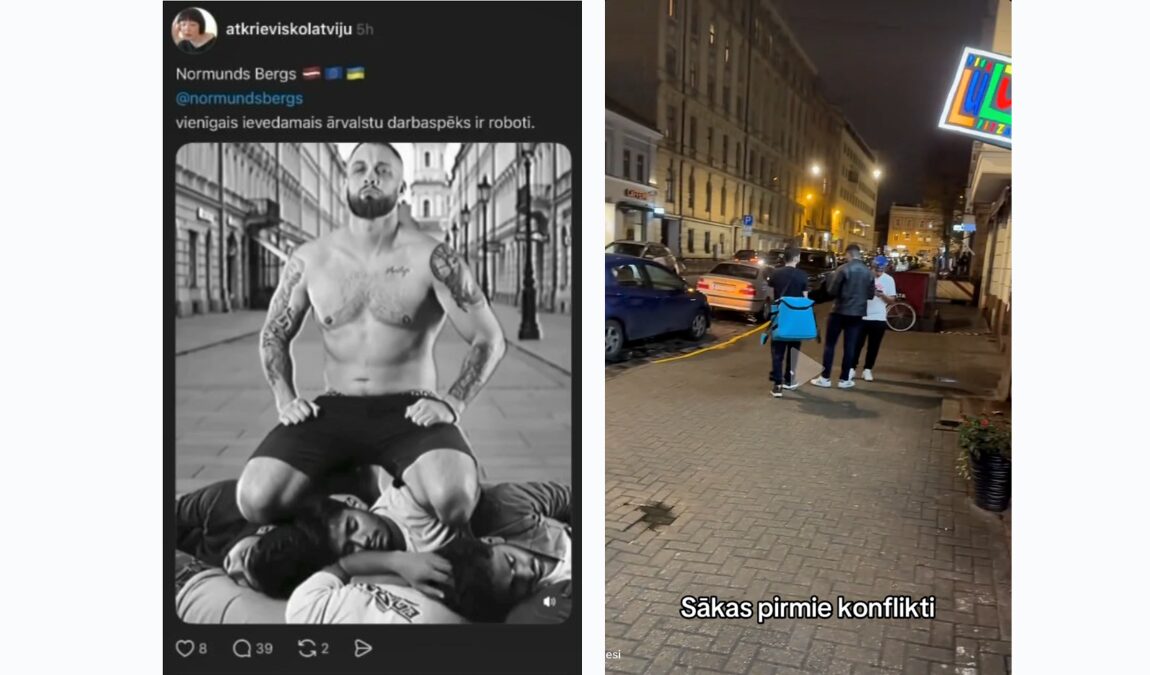
To frighten voters, they use both entirely fabricated stories about attacks that never happened and outright racism and hate speech. This summer, after a sexual assault report that later turned out to be fabricated, one prominent National Alliance politician referred to immigrants as “monkeys”. Another party member published an AI-generated video showing a white man whipping dark-skinned food couriers. Latvia’s top officials did not publicly condemn these messages. Migration researchers interviewed by Re:Baltica have said that this kind of political rhetoric emboldens others and can lead to real-world violence, with claims that women are under threat potentially serving as a pretext.
Although less intensively, false and racist messages about immigrants are also spread by Latvia First, Sovereign Power/Young Latvians Alliance and the Greens and Farmers Union, which is part of the current governing coalition. This comes despite Latvia’s relatively small immigrant population and persistent labour shortages reported by employers.
The Istanbul Convention and LGBTQ rights
As expected, the Istanbul Convention, a Council of Europe treaty that commits member states to reducing and preventing violence against women, also became a pre-election topic. In Latvia, it has long been a subject of political positioning and disinformation. Three years ago, after long and painful political battles, parliament ratified the convention. Two years later, however, after one of the parties returned to “conservative values”, parliament voted to withdraw from it. The decision sparked some of the largest protests Latvia had seen in years, and after the president intervened, the issue was ultimately left for the next parliament to decide.
During the election campaign, the convention’s most active opponents, Sovereign Power/Young Latvians Alliance and Latvia First, were the main parties reiterating their positions. In both social media videos and debates, Latvia First continued spreading false claims, including that the convention would require the legalisation of same-sex marriage. The party also submitted amendments to the Constitution that would establish that there are only two sexes (in Šlesers’ words, “to put an end to all this fuss about the Istanbul Convention and 117 genders”). A week before the election, a parliamentary majority voted to advance the proposal for further consideration. This may also foreshadow the next four years, with the new parliament expected to take a more conservative stance on women’s and LGBTQ rights than its predecessor.
The Green Deal
A more right-wing and populist approach is also expected on several other issues. The Green Deal did not become a major theme in this election, but several parties have used it actively to mobilise voters. For years, Sovereign Power/Young Latvians Alliance has spread misleading claims about wind energy, which would entail Latvia’s energy independence. During the campaign, the party has also collected signatures at campaign tents calling for ‘a Latvia without wind farms’. Individual Latvia First politicians also actively spread disinformation about wind and solar energy. The party describes the Green Deal as “Brussels’ green hallucinations”, which Latvia supposedly does not need because half the country is covered by forests and is therefore already green enough.
Prime Minister Kulbergs’ party, which polling suggests could win the largest number of seats in parliament, is also effectively calling for the Green Deal to be slowed down. It warns of enormous costs to the state budget and promises to abolish the Ministry of Climate and Energy after the election. Kulbergs himself has called the Green Deal a “pseudo-goal” and has repeatedly presented what amounts to a false dilemma: Latvia must choose between investing in the Green Deal or in defence, because supposedly it cannot afford both while the war in Ukraine continues. However, after moving from the opposition into the prime minister’s office, his rhetoric on this issue has also become more moderate.
NGOs and the media
Latvia First and Sovereign Power/Young Latvians Alliance regularly attack the media in a Trump-like fashion. They accuse the media of being controlled by the state and ruling parties, ignoring their activities and spreading fake news. Similar attacks on non-governmental organisations intensified this summer. Prime Minister Andris Kulbergs repeatedly made misleading public claims about their work and the state funding they receive. He said, for example, that NGOs are paid tens of thousands of euros every time they sit at the government table. He also accused the sector of wasting public money, claiming it receives around two billion euros from the state each year. He, however, failed to mention that the largest share of this funding goes to organisations providing social services on behalf of the state. Latvia First also joined in, angrily claiming on social media that public money was being spent all over the place.
What did we not see during the election campaign?
First, unlike during the municipal elections a year and a half ago, there was little disinformation about election fraud or stolen votes. It would have been easy to fuel such claims. First, after sudden technical problems, then officials decided overnight to count the votes manually. Second, this spring the state replaced the developer of the election platform at short notice following a procurement scandal and suspicions of corruption.
Despite this, we found only a few isolated instances of misleading claims about election interference. In one case, a popular pro-Kremlin blogger claimed that polling station staff and state security services could access votes cast during early voting. In another, a Latvia First candidate claimed without evidence that “hundreds, if not thousands” of young people had been deprived of their votes after supposedly being deceived at school through a critical-thinking education project about elections.
That does not mean such allegations could not appear later. After the municipal elections mentioned above, Latvia First, which ended up in opposition in Riga City Council, suddenly decided that the election had been stolen and even turned to law-enforcement authorities in an attempt to have the results annulled. The authorities found no significant violations.
AI use
Nor did we see the kind of vulgar personal attacks and severe smear campaigns against candidates that have appeared ahead of elections in other countries. Given the possibilities offered by artificial intelligence, producing such content would not have been difficult. A handful of videos, mostly published by pro-Kremlin accounts, depict Latvia’s leading politicians in highly unflattering ways using AI, but these have not attracted particularly large audiences.
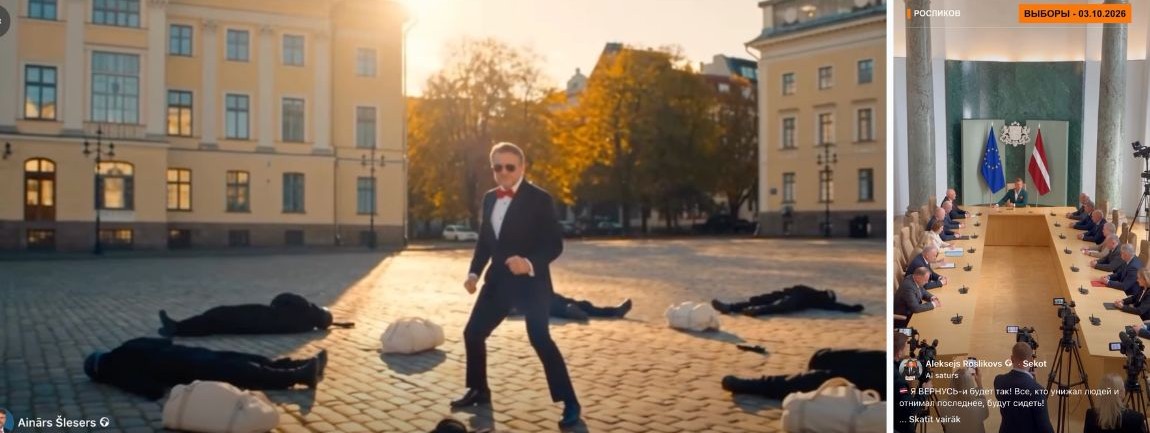
What we did see in full force, however, was AI slop – or slopaganda. Latvia First regularly published low-quality AI-generated videos depicting its leader, Šlesers, in various heroic roles: in one video, a flying Agent 007 beating up villains in central Riga; in another, as the boss of the White House, sitting around a table with the world’s most powerful leaders. In recent weeks, For Stability! leader Aleksejs Rosļikovs, who has moved to Belarus, has similarly promoted himself. He portrays himself as Latvia’s head of government, addressing submissive ministers in the same authoritative manner associated with Belarusian leader Alexander Lukashenko.