From propaganda to the courtroom: how Russia is building a legal case against the Baltic states
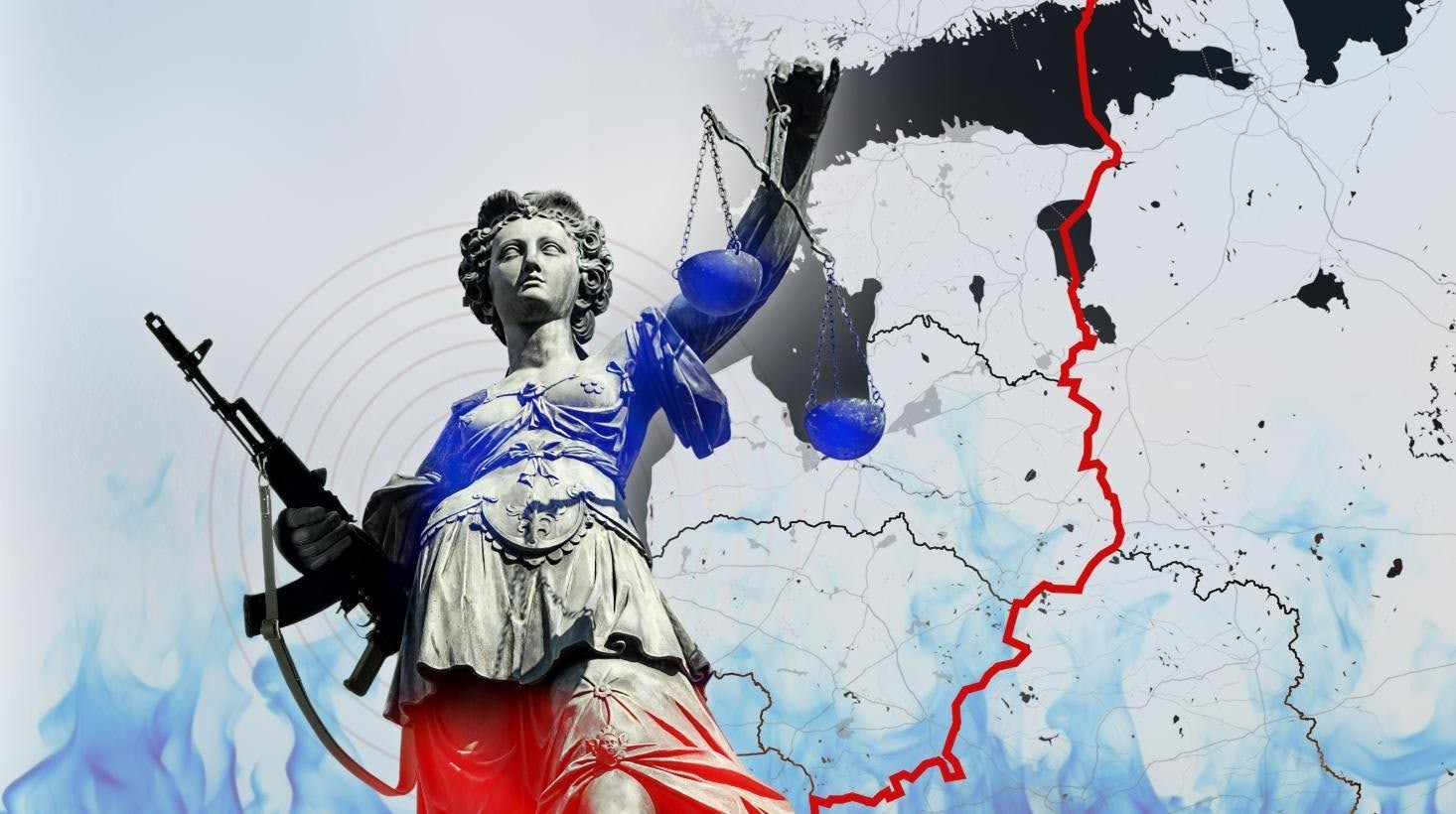
For years, the Baltic states dismissed the Kremlin’s increasingly outlandish claims – from implying they were allowing Ukrainian drones to strike Russia from their territory to allegations they were preparing to deport their native Russian speakers – as propaganda. Note, debunk, move on.
Now, some of those same allegations are appearing in what Russia says is a case-in-preparation against Estonia, Latvia and Lithuania before the UN’s International Court of Justice (ICJ). Latvia’s State Security Service (SAB) describes the Kremlin’s strategy as “lawfare”: the use of international law as part of hybrid war against the West, aimed at entangling adversaries in years of costly litigation while advancing Moscow’s political narrative.
A joint investigation by Re:Baltica, Delfi and LRT has found that as part of that effort Russia enlisted a Moscow law firm that has represented it in international litigation with Ukraine. The firm, in turn, sought help from propagandists tied to Russia’s intelligence services.
Start With All, Narrow to Baltics
Russia’s intention to take the Baltic states to the ICJ first became apparent in 2022.
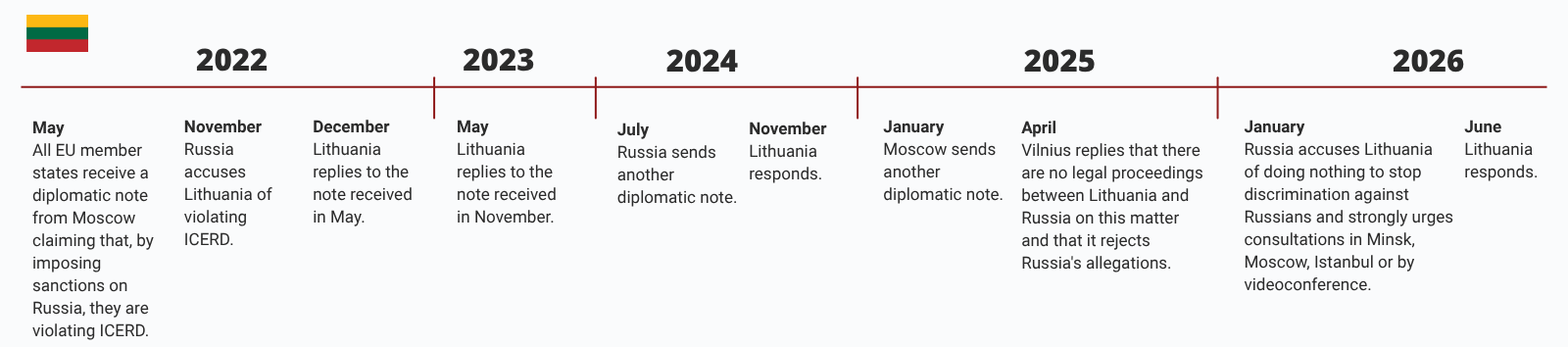
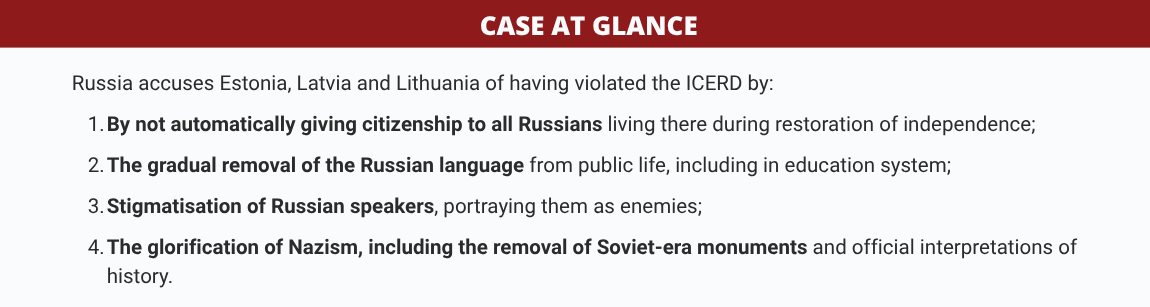
While Russia’s army was attacking Ukraine and killing civilians, its diplomats sent protests to every EU member state in May, arguing that sanctions for that violated the UN Convention on the Elimination of All Forms of Racial Discrimination (ICERD).
By the autumn, their focus had narrowed to Estonia, Latvia and Lithuania.
“In diplomatic practice, such a note can be regarded as a formal notification that a dispute exists,” said Diāna Eglīte, a spokeswoman for Latvia’s MFA. According to her, they contain no substantive legal arguments, relying instead on “facts presented through a subjective interpretation and wrapped in disinformation.”
That marked the beginning of lengthy diplomatic exchanges that continue until today. Wrapped in the language of courtesy, the documents appear to lay the ground for future litigation. Ignoring them is not an option. Failing to respond could later weaken the position in court.
Since then, Latvia and Lithuania have each received five diplomatic notes, while Estonia has four. Running to dozens of pages, they catalogue what Moscow describes as discrimination against Russians since the restoration of Baltic’s independence from Soviet occupation. It even cites the constitution of the Soviet republics, which guaranteed education in one’s native language it tried to suffocate. The notes quote politicians’ social media posts, recount parliamentary debates and cite media reports. They show that Russia closely monitors virtually every significant political and legislative development in the Baltics and recasts it into its own narrative.
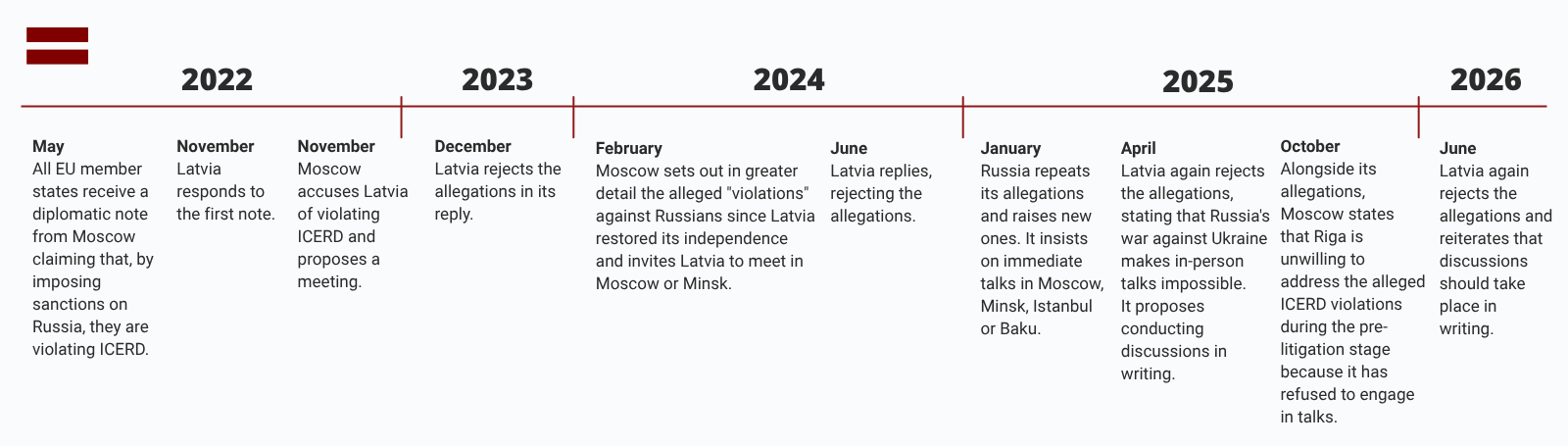
Russia has repeatedly invited the Baltic states to discuss its allegations – first in Minsk or Moscow, later adding Baku and Istanbul, and eventually offering a video conference. None has agreed to meet. Estonia responded it was willing to hold talks in The Hague, but only after Russia ended its war against Ukraine.

Lithuania’s MFA describes Russia’s allegations as legally and factually unfounded, and says that they serve, above all, a propaganda purpose. “Lithuania, together with Latvia and Estonia, drew the EU’s attention to Russia’s fabricated accusations under ICERD during the March 2026 meeting of the EU Foreign Affairs Council, and the EU high representative Kaja Kallas confirmed solidarity with the Baltic countries,” the ministry said.
For many Russian speakers in the Baltics, Moscow’s claimed concern rings hollow.
“Lithuanian Russians and their culture have become hostages of Putin’s Russia,” said Pavel Lavrinec, an associate professor in the department of Slavic studies at Vilnius University. “Putin’s Russians are fighting in Ukraine, and although we completely disagree with it, we are becoming responsible. Whether we like it or not.”
“The Lithuanian Russian community is very diverse, but probably the last thing Lithuanian Russians want is for Russia to defend their interests, because it is precisely Russia that has created the greatest problems for us.”
Engaging Propagandists

“Vladimir Vladimirovich, good afternoon,” began an email that landed in Vladimir Simindei’s inbox in July 2025.
Simindei is a Russian historian who spent his youth in Latvia before moving to Russia in the 90s. He later returned to Riga as an attaché at the Russian embassy before Latvia banned him from entering the country in 2012.
Officially, he serves as research director at the Historical Memory Foundation, a Kremlin-backed organisation dedicated to promoting Russia’s version of history. For years, one of his main lines of work has been portraying the Baltic states as sympathetic to fascism. Latvia’s SAB describes Simindei as “one of the most active organisers and executors of Russian influence operations targeting Latvia and the Baltic states”.
The sender of the email was Anastasia Taranova, a lawyer at Russia’s law firm Monastyrsky, Zyuba, Stepanov & Partners (MZS). “We are currently working with the [Foreign] Ministry on addressing the issue of discrimination against Russia’s population in the Baltic states,” she wrote.
Simindei was invited to prepare reports on the ethnic composition of each Baltic state, the historical presence of Russians, the development of the Russian language and education, and measures taken by the authorities that, in Moscow’s view, demonstrated that the governments of Estonia, Latvia and Lithuania had long been aware of what it calls the “Russian question”.
Another correspondent was Nikolai Mezhevich, president of the Russian Association for Baltic Studies, with proven ties to Russia’s security services.
MZS also is no ordinary law firm. One of its partners, Dmitry Lovyrev, is the son of a longtime FSB deputy director. The firm regularly wins Russian government contracts and represents Moscow in litigation brought by Ukraine over the closure of the Kerch Strait. Taranova was a member of that legal team.
Neither Simindei nor Mezhevich responded to requests for comment. MZS referred questions to Russia’s foreign ministry and declined to discuss its use of outside experts, saying it would not comment on information from anonymous sources or material that may have been obtained unlawfully. Russia’s MFA did not respond to requests for comment.
Preliminary Measures Are The Risk
Ieva Miļūna, a lecturer at the Riga Graduate School of Law, sees no violations of the ICERD in Russia’s allegations and describes Baltic prospects as “quite good.” “The measures Russia wants to challenge are Latvia’s efforts to deal with the legacy of Soviet occupation and russification,” she said.
Gleb Bogush, a Russian international law expert who previously taught at Moscow State University and now researches at the University of Cologne, said to LRT that the case should be taken seriously.
“Russia needs international platforms. A case against the Baltics before the ICJ would allow it to present propaganda narratives in legal language to an international audience. The danger is that the platform itself is credible. The case would be argued by professional legal teams, using legal arguments, evidence and procedure,” he explained.
“We have already seen similar tactics in Ukraine’s cases against Russia. Moscow has used those proceedings not only to respond to legal claims but also to advance broader political narratives, including allegations of corruption in Ukraine. In court, however, those narratives are presented as part of a legal dispute. That makes the propaganda more subtle and, in a sense, more effective.”
In the worst case scenario, ICJ could award Russia the compensation. It could also impose provisional measures at an early stage of the proceedings – which could be more problematic. “For example, it could order the restoration of Russian language instruction in Russian speaking schools from next term,” says Miļūna.
Latvia and Estonia were planning to switch to state-financed education in their native languages gradually and were in a process when Russia invaded Ukraine. That sped it up so fast that nowadays all state-financed education in Latvia can be conducted only in Latvian. Russian is not taught even as foreign language. In Estonia it still is, and schools will phase out Russian as the main instruction language by 2030.
Andres Parmas, Estonia’s former prosecutor general and an expert in international law, sees no legal base for Russia’s claims. He argues that migrant workers brought to Estonia during the USSR occupation had the opportunity to obtain Estonian citizenship after the restoration of independence: if they chose to take an oath of allegiance and learn Estonian. Today, numerous ethnic Russians are represented in Estonia’s political, business and cultural life.
Parmas recalls that throughout the 90’s Estonia’s minorities were closely monitored by OSCE High Commissioner: “They were ultimately satisfied with Estonia’s approach to Russian citizens and stateless persons in matters of citizenship. I would be surprised if, 30 years later, these claims were suddenly to succeed.”
However, provisional measures alone could pose a significant risk.”It would not mean the final judgment would ultimately go against us, but it would be a serious blow to our reputation. That is what Russia is counting on,” Parmas told Delfi.
The Costliest Case in Baltic Legal History?
Baltic officials say the significance of the case lies less in its legal prospects than in its political purpose.
“It is clear this is not about winning a court case or seeking justice,” Latvia’s MFA stated to Re:Baltica. “Through these hybrid attacks, Russia seeks to pressure Latvia and its allies into reducing support for Ukraine and changing their policy towards Russia.”
“Russia’s goal is to sow confusion, tie up our resources and spread doubts that perhaps we really are a small, nasty Nazi state,” said Kerli Veski of Estonia’s MFA.
Whatever the outcome, the case is likely to be lengthy and costly. Miļūna said proceedings could last anywhere from three to ten years, with legal costs running into millions of euros: “For Latvia, this could become the most expensive legal case in our history.”
No lawsuit has yet been filed. Russian MFA spokeswoman Maria Zakharova recently said the pre-litigation stage will be completed by the end of the year.
Latvia’s SAB has little doubt that a lawsuit will follow. The only question is when. “Russia is confident in its position and believes the ICJ offers a favourable environment,” the agency told Re:Baltica.
In its rare public report in June, 2026, SAB went further, warning that Moscow could also use the proceedings “as a pretext for direct confrontation with the Baltic states.” The reason could be its stated claim of defending Russian speakers wherever they are.
Show Must Go On
Last Thursday, all three Baltic chargés d’affaires in Russia jointly reiterated to Moscow that its statements about opening airspace to attacks against Russia and discriminating against Russians are false and indicate a deliberate Russian attempt to spread propaganda. They also called on Russia to end the war against Ukraine.
Marta Vunš (Estonia) and Anna Myroniuk (Ukraine) contributed to this report.