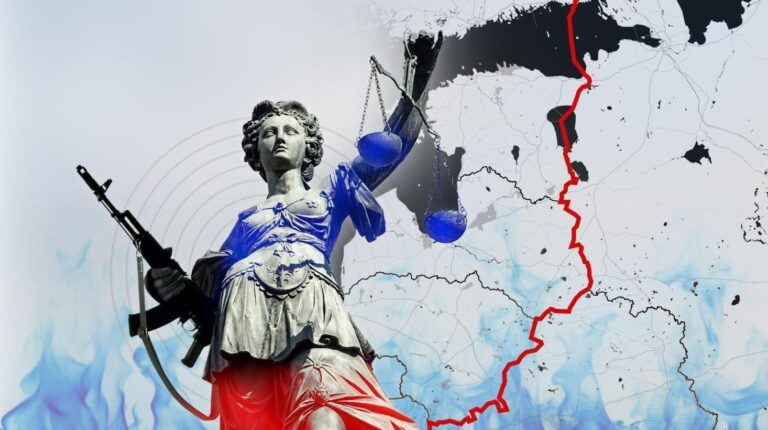
How Russia Uses Video Games for Propaganda

A robot styled after Yulia Tymoshenko; a 17th‑century Muscovite guardsman sneering at Europe’s “effeminate” men; the chance to step into the boots of a modern Russian soldier invading Ukraine — all of this appears in video games released in Russia over the past four years.
Is the Kremlin deliberately using video games as another propaganda tool? How effective is this strategy? And what can be expected next?
Atomic Heart: Soviet retro‑futurism
Atomic Heart was released on 21 February 2023, almost exactly one year after Russia launched its full‑scale invasion of Ukraine. It became the most internationally successful Russian‑made video game in roughly the last 15 years.
Officially, Atomic Heart was not financed by the Russian state. Yet circumstantial evidence suggests links between the game’s developer, Mundfish, and Russia’s state‑owned energy giant Gazprom. One of Mundfish’s investors is GEM Capital, founded by Anatoly Paliy, a former Gazprom employee. GEM Capital has invested heavily in video games. Atomic Heart remains its most successful project.
Whether the game itself qualifies as propaganda is debatable. Atomic Heart is set in an alternative 1955 Soviet Union, a world of robots, artificial intelligence and super‑technology. Some critics argue that it romanticises the USSR and promotes a mythologised vision of a “Russia’s strong past.” More likely, this stylised Soviet setting serves primarily as a visually striking backdrop.
Still, certain details invite closer scrutiny. Among the game’s enemies are twin robots named Left and Right, whose hairstyles closely resemble that of former Ukrainian Prime Minister Yulia Tymoshenko. The resemblance is unlikely to be accidental, though the game also contains satirical references: another robot, Vovchik, sports a moustache reminiscent of Belarusian dictator Alexander Lukashenko.
References to the war in Ukraine are indirect. Players encounter drones decorated with geranium pots — widely interpreted as a nod to Russia’s “Geran” drones used in attacks on Ukrainian cities.
Ultimately, Atomic Heart’s greatest propaganda value may lie in its quality. The game received favourable reviews from Western outlets (IGN: 8/10; PC Gamer: 78/100; Hardcore Gamer: 4.5/5). According to Metacritic, critics rated it 76/100, while players gave it 7.4/10. It earned nominations for the Hollywood Music in Media Awards and the Annie Awards, made into the BAFTA longlist, and won Steam’s 2023 award for best visual style.
Calls by Ukrainian activists to boycott the game — arguing it benefited Russia financially and reputationally — failed to curb its global availability. In Latvia, it still sells for around €60. Russian state media figures, including prominent propagandist Vladimir Solovyov, enthusiastically promoted it. Even if not conceived as propaganda, Atomic Heart ultimately functioned as one.
Smuta: a state‑backed historical failure
Smuta (from the Russian word for “time of troubles”) was a state‑backed project almost from inception. Development began in 2020, but the project was formally announced in 2022, when it received a grant from the Institute for Internet Development — a Kremlin‑linked organisation tasked with promoting pro‑government narratives online and placed under EU sanctions in June 2024.
Set in 1612 during civil war and foreign invasion, the game casts players as defenders of the Russian state against Polish and Swedish forces. Unlike Atomic Heart, Smuta is widely regarded as a sloppy game. Players reported severe technical problems, repetitive gameplay copied from Western titles, and dated graphics.
The game is unavailable in Western markets and is sold exclusively through VK Play, owned by the Russian social network VKontakte, for about €6.60. The IID invested roughly 490 million roubles in the project; total development costs are estimated at around one billion roubles — expenses the game is unlikely ever to recoup.
While Ukraine is never mentioned directly, Poles and Germans are depicted almost exclusively as enemies. Contemporary ideological messaging appears in dialogue, including an anachronistic transphobic rant voiced by the protagonist — rhetoric closely aligned with modern Russian propaganda, despite being wildly out of place in a 17th‑century setting.
Another scene suggests that, for victory, all property — even “wives and children” — must be surrendered to the state. While framed within the historical narrative, the implication resonates uncomfortably with present‑day Russia.
Despite heavy state backing, Smuta failed to gain traction even domestically. Russian MP Vitaly Milonov suggested the developers might have been “recruited by Polish intelligence” to sabotage the project — a telling response to its failure.
Unit 22: ZOV — gaming the war in Ukraine
Unit 22: ZOV is, to date, the only video game explicitly centred on Russia’s war against Ukraine. It portrays the conflict as a “liberation” campaign beginning in 2014. Players control Russian forces across several campaigns occupying Ukrainian territory.
The developers openly acknowledge consultations with Russian military officers and Donetsk separatists, and list the Russian armed forces as an information partner. Players can only fight on the Russian side; Ukrainian perspectives are absent. Russian soldiers are portrayed as highly ethical, and the game uses the names of real‑world war criminals.
The result is an unequivocal propaganda product — and a commercial failure. Steam data shows a peak of just 50 simultaneous players at launch. Today, the game is effectively played only in Russia and Belarus. While nominally free, most content requires payment, bringing total costs close to €60.
Even pro‑Kremlin Telegram channels have largely ignored it.
Not a uniquely Russian strategy
Using video games for propaganda is not a Russian invention. The U.S. Army’s America’s Army series, released between 2002 and 2009, aimed to promote military service. A 2008 MIT study found it had a greater recruitment impact than all other army advertising combined. The project was discontinued in 2022.
China, India and Middle Eastern actors have pursued similar efforts, ranging from state‑funded military simulators to overtly political games depicting real conflicts. Even European political parties experimented with games: Germany’s Social Democrats released Abenteuer Europa before the 1994 European Parliament elections.
In 2025, Steam released Bridge Hunter, a €9.75 game allowing players to destroy the Crimean Bridge — with no official ties to the Ukrainian state.
What comes next
President Vladimir Putin has repeatedly called for the development of “Russian computer games that teach respect for history,” while urging tighter control over titles portraying Russia negatively. IID plans to finance games worth 3.4 billion roubles between 2025 and 2027.
New state‑funded releases avoid overt wartime themes, instead presenting neutral or favourable portrayals of Russia: Undying Symphony (about the siege of Leningrad), Saturn (a science‑fiction exploration game), and SOF: Enemy from the Future (soldiers defending Earth from aliens). All are free to play.
More titles are forthcoming, including Northern Path, an exploration game set in Siberia, and Front Edge, a strategy game depicting “modern military conflicts.”
While Europe bans Russian television and blocks many online propaganda channels, video games largely escape scrutiny. With the exception of Smuta, all of the titles discussed here remain legal in the EU, including Latvia — even overt propaganda such as Unit 22: ZOV.
For now, their impact remains limited.
Author: Artjoms Ļipins, TVNET, for Re:Baltica
Editor: Sanita Jemberga
Illustration: Miko Rode
Technical support: Madara Eihe
*Translated into English using the machine translation tool DeepL.com


INDEPENDENT JOURNALISM NEEDS INDEPENDENT FINANCING If you like our work, support us! LV38RIKO0001060112712