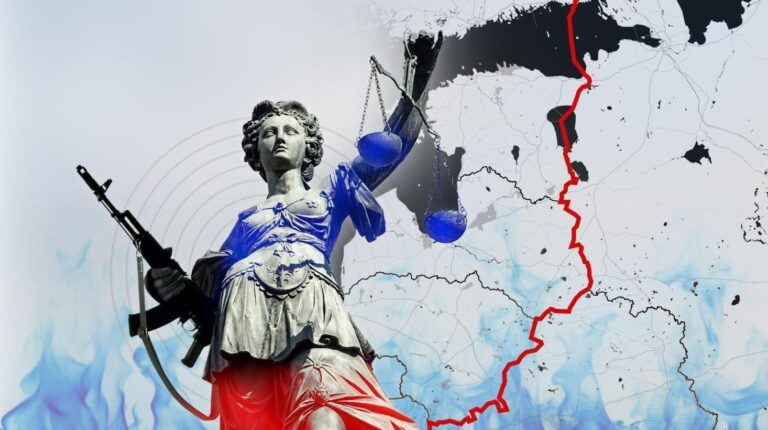
Could Russia Attack NATO and Latvia? What Z-Bloggers Are Saying

Is Russia preparing for a potential war with NATO? The question has loomed large since Moscow launched its full-scale invasion of Ukraine, resurfacing again and again across political and security circles. While Western intelligence chiefs continue to strike a cautious tone in their public assessments, Europe’s rapidly rising defense spending tells a more urgent story — one that suggests the threat is no longer viewed as hypothetical.
In Russia, the answer comes from either Kremlin TVs propaganda where sanctions are failing, Europe is weakening, Ukraine will surrender, and Vladimir Putin will ultimately be proven right, or from military Telegram channels — the so-called “Z-bloggers.”
Z-bloggers function as a one-sided record of the war and of thinking within Russia’s military circles. They are read by millions (Telegram is used by an estimated 76 million people in Russia) Even now as authorities move to restrict the platform, officials have signalled these accounts will remain untouched.
Z-bloggers broadly echo the official line: Russia is right, Ukraine must lose, and the West is in moral decline. But they also highlight problems — reporting shortages, criticising commanders and acknowledging battlefield setbacks — offering a more granular, if still biased, view of the war.
“The narrative of a Russia besieged by a hostile West has been part of Putin’s arsenal since the early 2000s. What we see now is a more radical version,” said disinformation researcher Mārtiņš Hiršs. “The war is not going well, the economy is struggling — but almost anything can be justified as defending the nation from a hostile enemy.”
According to Hiršs, Z-bloggers offer a clear window into how Russia’s information space operates in practice. The Kremlin sets the core political lines and key messages on the war, the West and Ukraine, but much of the propaganda is disseminated in a decentralised way.
State-controlled television and official media amplify these narratives first, after which they spread across a broader information ecosystem. Z-bloggers and pro-Kremlin influencers pick them up, reinterpret and intensify them.
“Their content is often more radical, more emotional and more aggressive than the relatively dry and disciplined messaging of the state,” Hiršs said. “Some of these influencers are linked to state institutions or media outlets, and in some cases even funded by them. Others operate more independently — much like influencers in the West — monetising attention through clicks, audiences and visibility.”
What are Z-bloggers?
Z-bloggers are a sprawling network of Telegram accounts united by their support for Russia’s invasion of Ukraine and their regular reporting on the war. Most of these channels emerged after the full-scale invasion in 2022, though the first appeared following the annexation of Crimea. The name comes from the “Z” symbol associated with Russia’s aggression.
The network includes Kremlin TV propagandists, guests presented as experts on their shows, pro-regime military correspondents, channels linked to the Defence Ministry, content aggregators, Wagner-affiliated figures, Kadyrov loyalists, and individuals close to or directly involved on the front line.
Researcher Ivan Filippov, who studies Z-channels, has described their emergence as a byproduct of media censorship in Russia and the Defence Ministry’s persistent misinformation. More on the phenomenon can be found in his reporting for Meduza.
Z-bloggers influence

Data was collected in February 2026. The analysis includes manually identified Z-bloggers who commented on the possibility of a war with NATO on Telegram during the fourth quarter of 2025
Is World War III already underway?
The central question is whether Russian and NATO forces could end up in direct military confrontation — not just hybrid operations or cyberattacks.
Some Z-bloggers dismiss the risk. Ugolny #DadzhalPetukh says conflict is unlikely because Western militaries are “not foolish enough” to rush in unprepared — adding, without evidence, that if war comes, the West will be to blame and Russia will win easily.
Others argue the war is already underway, just not openly. Hard Blog Line claims Russia has created no grounds for conflict — ignoring it’s invasion of Ukraine and sabotages in Europe — while urging preparedness to keep the risk low.
The message is consistent: war is unlikely; if it happens, Europe is at fault.
But not all agree. The more prominent Zapiski Veterana now says conflict is “not inevitable, but increasingly likely,” outlining scenarios where NATO triggers escalation. Analysing the situation on the front line and comparing the military capabilities of both sides, the Z-blogger outlines three possible scenarios — none of which cast Russia as the aggressor. According to Zapiski Veterana, NATO would either stage a provocation, deploy troops to Ukraine, or impose a military blockade on Kaliningrad — prompting Russia to seize the Suwałki corridor.
“A direct, large-scale war between Russia and NATO is unlikely due to the nuclear factor. The most plausible scenario is a limited but intense conflict involving NATO in Ukraine,” the author concludes.
Some go further. Yansen | Z argues Europe will start a war to preserve its elites.
Who is to blame?
Even in hypothetical scenarios, Z-bloggers consistently place the blame on the West.
The channel ЖИВОВЪ argues that Russia needs military victories in Ukraine now — but adds that even “stunning successes” would not stop the EU from pursuing its military plans.
Hard Blog Line goes further, claiming Europe “needs” war to offset the loss of the Russian market. “They need a pause to prepare Ukraine for a new war with Russia. It will all begin with provocations that will force us to launch a ‘special military operation 2,’” the author writes.
The theme is most actively pushed by Dva Mayora, one of the most prominent Z-bloggers, whose Telegram channel reaches around 1.2 million subscribers. In December, it wrote that Russia’s military and political leadership views the ongoing militarisation of EU countries as preparation for a war with Russia “around 2030.”
A day earlier, it cited another major Z-blogger, Arkhangel Spetsnaza, who claimed that NATO states are steadily increasing military spending “despite falling incomes, inflation and economic decline.”
In this framing, virtually any European defensive measure is cast as provocation. Commenting on Denmark’s deployment of air defence systems and naval mines in the Baltic Sea, Dva Mayora argued such steps are “effectively laying the groundwork to provoke Russia into retaliatory measures,” which could then justify war by the EU and NATO.
Against this backdrop, Zapiski Veterana stands out.
On December 29, responding to Ukrainian President Volodymyr Zelensky’s call for Western security guarantees — potentially including troops — the channel wrote: “He knows this is unacceptable to Russia, and we will be forced to start World War III, which will escalate into nuclear war, in order to defend ourselves.”
Unlike most Z-bloggers, Zapiski Veterana explicitly suggests that Russia would initiate a global war — albeit as a forced response. That marks a notable shift in tone.
What happens next?
Despite frequent predictions of war, Z-bloggers are far less willing to discuss how it would end.
Some remain confident. There are some like NgP razVedka who boast that a single Russian group attacking Ukraine could “sweep NATO forces in the Baltics aside without even noticing them.”
Others are more cautious. Romanov Light acknowledges that Russia’s Black Sea fleet lags far behind NATO — “the gap in both numbers and equipment is enormous,” he writes, describing it as “essentially a 20th-century fleet built on the remnants of the Soviet empire.”
Direct comparisons with NATO are rare — and usually framed as questions rather than conclusions.
One such question came from Z-blogger Anastasia Kashevarova, a former state TV journalist and parliamentary adviser, who submitted queries for Putin’s televised call-in show. She pointed to systemic problems in Russia’s military — equipment failures, shortages of personnel and resources, and unfulfilled promises — before asking: is Russia actually ready for war with NATO? Would it again lack even basic gear, manpower or critical components?
It was never aired.
A shift in tone is also visible elsewhere. The channel Ugolny #DadzhalPetukh, once confident Russia would easily win a near-term war, began to hedge by November. War with Europe, its author now argues, is simply “not necessary” — suggesting Russia should first “finish with Ukraine.”
Conclusion: Across the Z-blogosphere, two messages dominate: Russia and NATO will end up at war — and the West, particularly Europe, will be to blame. But confidence about the outcome is far less uniform. Some claim Russia’s army, hardened by the war in Ukraine, is ready to prevail. Many others raise a more uncomfortable question: if Russia has spent years struggling to defeat Ukraine — advancing slowly against an opponent backed by only partial Western support — what would happen if it faced the full force of NATO?


INDEPENDENT JOURNALISM NEEDS INDEPENDENT FINANCING If you like our work, support us! LV38RIKO0001060112712