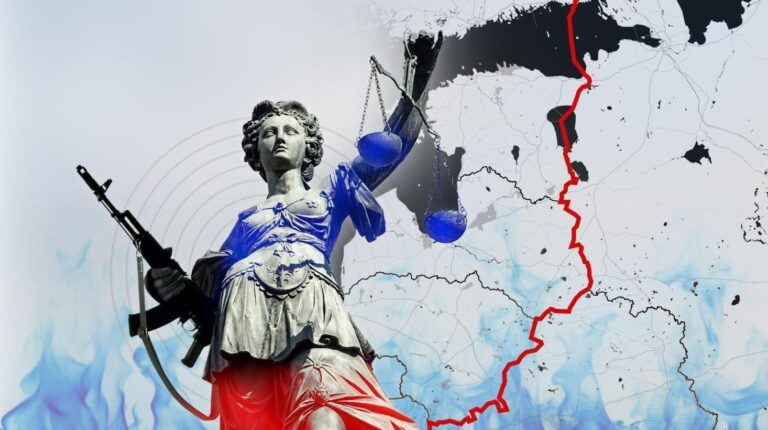
Russian Historian Expat in Latvia Leads Kremlin-funded “Russophobia” Research

Leaked documents show Valery Engel seeking money from Russia’s soft power fund under the EU sanctions.
Valery Engel, a Russian historian residing in Latvia who for years promoted Kremlin narratives about the alleged resurgence of fascism in Latvia with money from Russia’s soft-power organization, has continued doing exactly that after the fund had been placed under EU sanctions. His focus shifted to alleged “Russophobia” in Europe and Ukraine.
Evidence of Engel’s current activities was uncovered by the Ukrainian service of Radio Free Europe/Radio Liberty’s investigative project Schemes, with the help of the latest document leak from Russia’s soft-power foundation for the protection of compatriots abroad, known as Pravfond. The investigation was a collaboration with the Organized Crime and Corruption Reporting Project (OCCRP) and Re:Baltica.
Despite the EU placing Pravfond under sanctions in 2023, Engel has requested its support at least twice since then and apparently received the funding at least once. He, however, categorically denies that.
Receiving funding from an EU-sanctioned entity is a criminal offence in Latvia. Finance Intelligence Unit (FIU), which oversees sanctions compliance, told Schemes that it will investigate whether Engel has broken the law. Meanwhile, Latvia’s State Security Service asked the Interior Minister to place Engel on a blacklist of persons banned from entering or residing in the country.
Who Is Engel?

In 2014, when Russia illegally annexed Crimea, Engel was part of what Re:Baltica described as the Kremlin-funded “travelling circus.” The group gathered around MEP Tatjana Ždanoka, who worked in the interests of the Kremlin. Russia financed various pseudo-organizations that existed only to spread Kremlin narratives internationally while posing as independent experts. They also attended one another’s events, seeking to create the impression of broad international support for Kremlin policies.
In Latvia, the group — some of whose members are currently in prison in the Baltics for crimes against the state, others expelled, and others having fled to Russia — was particularly active around Legionnaires’ Remembrance Day on 16 March, which they portrayed as evidence of the rebirth of nazism.
Back then, Engel was vice-president of World Without Nazism, an organization founded by Russian billionaire Boris Spiegel. He took part in roundtables Ždanoka organised in Latvia as well as OSCE and UN events in Warsaw and Geneva. His work there, as well as on Russian propaganda channels, was to complain about the alleged discrimination of Russians and the resurgence of fascism in the Baltics and Ukraine. Engel also served as editor of the organization’s main “product” — a report on xenophobia in various European countries.
According to the leaked documents, it was financed by Moscow. Russia channelled money to Engel so he, as the head of the Latvia-registered “European Centre for the Development of Democracy,” produced the report, which turned annual.
In recent years, Engel had kept such a low profile in Latvia that he was almost forgotten: until now.
Now – Against “Russophobia”
Leaked documents show that in 2024, Engel requested €41,000 from Pravfond to prepare a report on “Russophobia in Europe and Ukraine.” He submitted the grant application in March 2024 on behalf of his Latvia-registered organization.
“Sanctions policy, artificial obstacles to personal contacts between citizens of Russia and EU countries, discrimination not only against Russian citizens but also against Russian-speaking residents of the EU, as well as the activities of various nationalist and radical organizations with a Russophobic orientation — all of this leads to serious violations of the fundamental rights of the Russian-speaking minority,” he wrote in the application. “The relevance of the topic is greater than ever.”
The report was intended “to draw attention to alleged violations of the rights of the Russian minority in the EU countries and Ukraine.” The planned presentations of the report included the OSCE Human Dimension Conference in Warsaw and at a session of the UN Human Rights Committee in Geneva in the fall of 2024. Later, on December 10, it was also to be presented on Human Rights Day in Moscow, a city Engel visits regularly.


Engel was about to release the report in both Russian and English. However, under different names. While the Russian title was simply “Russophobia in Europe,” the English version was more veiled: “Violations of State and Minority Rights in the Post-War Period (Fatal Mistakes of Governments in the Context of Building Inclusive Societies in Europe).”
As explained in the project description in the grant application form, this was needed because the participating researchers from Western universities were to publish the work in their outlets. Each of the 15 experts was to be paid €1,500.

Engel’s study is nowhere to be found in open sources. However, a similar publication – “On Human Rights in Certain Countries” – was released in 2025 by the Russian Ministry of Foreign Affairs (MFA), which oversees Pravfond. In the 1,850-page document, the word “Russophobia” is mentioned more than 50 times.
Previously – Against Xenophobia
Another application that preceded Engel’s grant request for a “Russophobia” study is his research on “xenophobia,” submitted to the Russian state organization in November 2022. For this project, Engel’s Latvian organization requested €22,400.
The application claimed that since Russia’s full-scale invasion of Ukraine, “the most discriminated minority in Europe is (…) Russian compatriots,” who allegedly suffer from “ethnically discriminatory policies” and “associative xenophobia.”

The project, titled “Extremism, Xenophobia and Hate Crimes in the OSCE 2021–2022,” aimed to “combat disinformation and create better positions for Russia in human rights issues, especially minority rights,” compared to other countries that belong to the OSCE. According to the documents that journalists examined, Engel’s study was to cover 13 countries, including the United States, Canada, and Ukraine (the Baltic states were not included this time). The report was to be presented at international forums, including the UN and OSCE.
Schemes found leaked files indicating that Pravfond had approved this November 2022 application.

Among them is a funding agreement between Pravfond executive director Alexander Udaltsov and Engel. Engel emailed the signed contract to Udaltsov on December 21, 2022, from an email address on the Russian domain @rambler.ru.
Pravfond itself explicitly stated in a draft of its 2022 annual report that it financed the project.

Engel also requested money to present this report on the sidelines of the OSCE conference in Warsaw in the autumn of 2023. This was supported by Russia’s Foreign Ministry, which immediately dispatched the support letter to Pravfond. In it, Engel is described as a successful researcher and international speaker, as well as “an organiser of high-level events held parallel to human rights forums.” The ministry asked Pravfond to provide Engel with financial assistance to attend Warsaw’s event. Schemes found at least three occasions when the Russian MFA had supported Engel’s initiatives.

On October 5, 2023, Engel presented the Pravfond-supported report co-authored with Ukrainian political analyst Ruslan Bortnik, as confirmed by the OSCE conference agenda.
An OSCE spokesperson, Katya Andrus, said that the organization’s human rights conferences are “open to a broad range of stakeholders” and that the body does not vet participants’ sources of funding.
“Participation in such events does not imply endorsement by the OSCE of the views expressed by any speaker, nor of their institutional affiliations or funding sources,” Andrus said.
In September 2023, Engel emailed Pravfond. He wrote that the project had been completed and shared the link to the report, published on the Russian-language version of his website, Civic Nation. According to the leaked documents, this is where publications funded by Pravfond were supposed to appear.

Another piece of evidence indicates that Engel could have coordinated his actions with the Russian fund: according to leaked data from mobile operator MTS, he made phone calls and exchanged messages with representatives of Pravfond before and during the Warsaw conference.

What is Pravfond?
Pravfond is one of Russia’s soft-power foundations. Its declared mission on paper is to defend the interests of “compatriots” abroad. In practice, this often translates into financing its own political interests. Previous investigations show that after being placed under sanctions, the foundation paid its activists in European countries in cash or via third-party bank transfers. In an internal report, journalists found in the trove of leaked data, it claimed that sanctions had not significantly affected its operations.
Engel’s Associates
Ruslan Bortnik, whom Engel names a researcher for the Ukrainian part of his xenophobia and Russophobia reports, is a Kyiv-based political analyst. He is also the director of the Ukrainian Institute of Politics and the founder of the political school bearing his name.
But Bortnik is known beyond Ukraine. He has also repeatedly appeared as an expert on Latvian Radio 4 (which broadcast in the Russian language until 2026) show “Podrobnosti” (“Details”). Its host, Juliāna Škagale, told Re:Baltica that she does not recall who exactly extended Bortnik an invitation. Journalists often share contacts, making it difficult to trace the original source, she said. “However, I want to stress that if we had even the slightest suspicion or any information about questionable ties, pro-Russian positions, or anything of that nature concerning Bortnik, he certainly would not have appeared on our programme,” Škagale added.
Another of Engel’s associates is Semyon Charny, also a Russian historian, just like Engel himself. Charny was to lead his research on the Baltic countries in the “Rusophobia” project from 2024.
Both Charny and Bortnik have been guests in “Riga forum,” the conference devoted to holocaust research, coorganized by Engel.
Approached by Schemes, Bortnik denied any involvement with Engel’s project. “I am a world-famous expert. Nowadays, my name can be attached to any project (without him knowing – ed.),” he said. Charny didn’t respond to the journalists’ requests for comment by the time of publication.
As for Engel, not only did he deny receiving any money from Pravfond after 2022, he said he hadn’t even asked for funding.
“I can assume this is either some kind of provocation or, as often happens with Russian state finances when their budgets are cut, they fabricate applications themselves to preserve them. I have submitted nothing, received nothing, and I am outraged by this situation,” he said, adding that his reports “do not require funding.”
Schemes verified the email address used to send some of the grant applications to Pravfond. According to leaked Mail.ru user data, it is linked to Engel’s Russian phone number — the same one he uses for Telegram and WhatsApp.
Journalists also compared the signature on his 2024 grant application with Engel’s signature in his Russian passport (a copy he provided to Pravfond in 2015) and with the signature in the charter of his Latvian organization Re:Baltica obtained from the state registry — allowing readers to assess the similarity themselves.

Schemes also reviewed the metadata of the 2023 grant application for funding to attend the OSCE event, sent from Engel’s email address to that of Pravfond. Using multiple metadata analysis tools, the journalists found that the documents’ most recent modifications were made by a user identified as “Valery Engel.”
What Happens Next?
Latvia’s Financial Intelligence Unit (FIU), which oversees sanctions compliance, told Schemes that “a sanctioned entity may not transfer or hand over cash to another person.” Therefore, if Engel or his NGO received funds from a sanctioned organization, the money should have been frozen, and the event reported to the FIU. Responding to Schemes’ request for comment, FIU said that it would investigate the matter.
Following an earlier Re:Baltica investigation into Engel’s activities shortly after the annexation of Crimea, Latvia’s State Revenue Service began auditing his Latvian-based NGO. But the state agency refused to disclose the inspection’s results then, and now. It again declined journalists’ requests to share information, including on whether it has since taken a closer look at Engel’s organization.
On February 18, when this story was being prepared for publication, Latvia’s Security Service (VDD) asked the Interior Minister to place Engel on the blacklist, barring him from entering and residing in Latvia. “Through his activities, Engel has long and systematically participated in the implementation of Russia’s non-military influence measures and in the justification of Russia’s aggressive foreign policy,” the intelligence agency said in the statement to Re:Baltica.
VDD added that even after Russia’s full-scale invasion of Ukraine broke out, Engel has continued to maintain close ties with Moscow, “as well as to engage in activities aimed at justifying Russia’s aggressive foreign policy and internationally discrediting European countries, including Latvia.”
As a result, Engel was eventually blacklisted to “prevent a threat to Latvia’s national security.”

Paying Latvian lawyer-turned-politician
Pravfond not only financed the work of “Kremlin historians,” but also their lawyers when they encountered problems. In Engel’s case, this first happened when Latvian authorities refused to extend his residence permit. He was represented by Elizabete Krivcova, who is one of Latvia’s most prominent activists in Russia’s compatriot policy.
Engel requested €3,500 from Pravfond for legal expenses in 2015, when he was better known in Latvia as a representative of “World Without Nazism.” In the application, Engel claimed that authorities were refusing to extend his residence permit in retaliation for his fight against the “glorification of nazism,” such as criticising 16 March marches or working on the “White Book of Nazism.”
He claimed that, if stripped of a Latvian residence permit, he would lose the ability to travel to Russia. And if he does, he won’t be able to return to Latvia to his family (leaked flight and border-crossing data show that Engel visited Moscow regularly).
Krivcova succeeded in securing a one-year extension back then. In 2017, she herself requested €500 from Pravfond for work on Engel’s permanent residence permit. The Russian fund supported the application and was prepared to cover her legal expenses for a year, according to a contract obtained by Schemes. The case continued for years – in 2021 the Senate of Latvia’s Supreme Court rejected Engel’s claim for a permanent residence permit.
Krivcova appealed to the European Court of Human Rights, arguing that Latvia was violating his right to family life. She was paid €790 for this work.
In March 2022, Krivcova authorised Engel to receive the Pravfond funds intended for her, documents show.
A month later, the ECHR dismissed the application.
Krivcova didn’t answer Re:Baltica’s request to comment whether she received money from Pravfond for Engel’s defence, stating that she could not provide information about clients without their consent. When asked how often she received money from the fund, Krivcova recalled one instance: “More than 10 years ago, a non-governmental organisation I represented received approximately €600 from Pravfond to cover transport and hotel expenses for participation in a conference in Warsaw.”
Last time she represented Engel was in 2021, Krivcova said. She added that after Pravfond was placed under the EU sanctions, she has neither maintained contact nor cooperated with representatives of the fund.
Editor’s note: This article was published as part of the Fighting Against Conspiracy and Trolls (FACT) project, an independent, non-partisan hub launched in mid-2025 under the umbrella of the EU Digital Media Observatory (EDMO). Click here to follow the latest stories from our hub on disinformation.

INDEPENDENT JOURNALISM NEEDS INDEPENDENT FINANCING If you like our work, support us! LV38RIKO0001060112712